Chapter 11
Refining Jing 精 to Qi 氣
Essence becomes breath; breath becomes spirit.
Conservation First
Before refinement, conservation. Most lose more essence 精 (jing) in a day than they could refine in a week — through restless desire, broken sleep, ungoverned speech, and chronic anxiety.
Concentrating the breath until it is soft — can you become as a newborn?
The Three Treasures Revisited
When the vital essence (jing 精) is preserved within, it generates itself; outwardly it spreads in tranquility.
The Direction of the Work
Refine jing 精 into qi 氣; qi into shen 神; shen returns to the source. Each stage requires the previous as fuel. Without a full reserve, there is nothing to refine — which is why there is no shortcut around conservation.
Within, nourish yourself, serene and quiescent in empty non-being. Returning to the fundament, conceal your light, and inwardly illumine your body.
Leaks
Common leaks: chronic overwork, gossip, indulgent rumination, broken sleep, restless desire, perfectionism, and the long argument with what cannot be changed.
The qi 氣 is nourished straight, without harm (qi yi zhi yang er wu hai 氣以直養而無害); the jin 勁 is stored curved, with surplus to spare (jin yi qu xu er you yu 勁以曲蓄而有餘).
Practices of Gathering
The Slow Yield
Refinement is not dramatic. It shows as steadiness — slower reactions, longer breath, lighter sleep, a face that holds its colour. The Neiye 內業 praises this quiet glow.
Core Lesson
Conserve, then refine. Essence becomes breath; breath becomes spirit.
Practice for this lesson
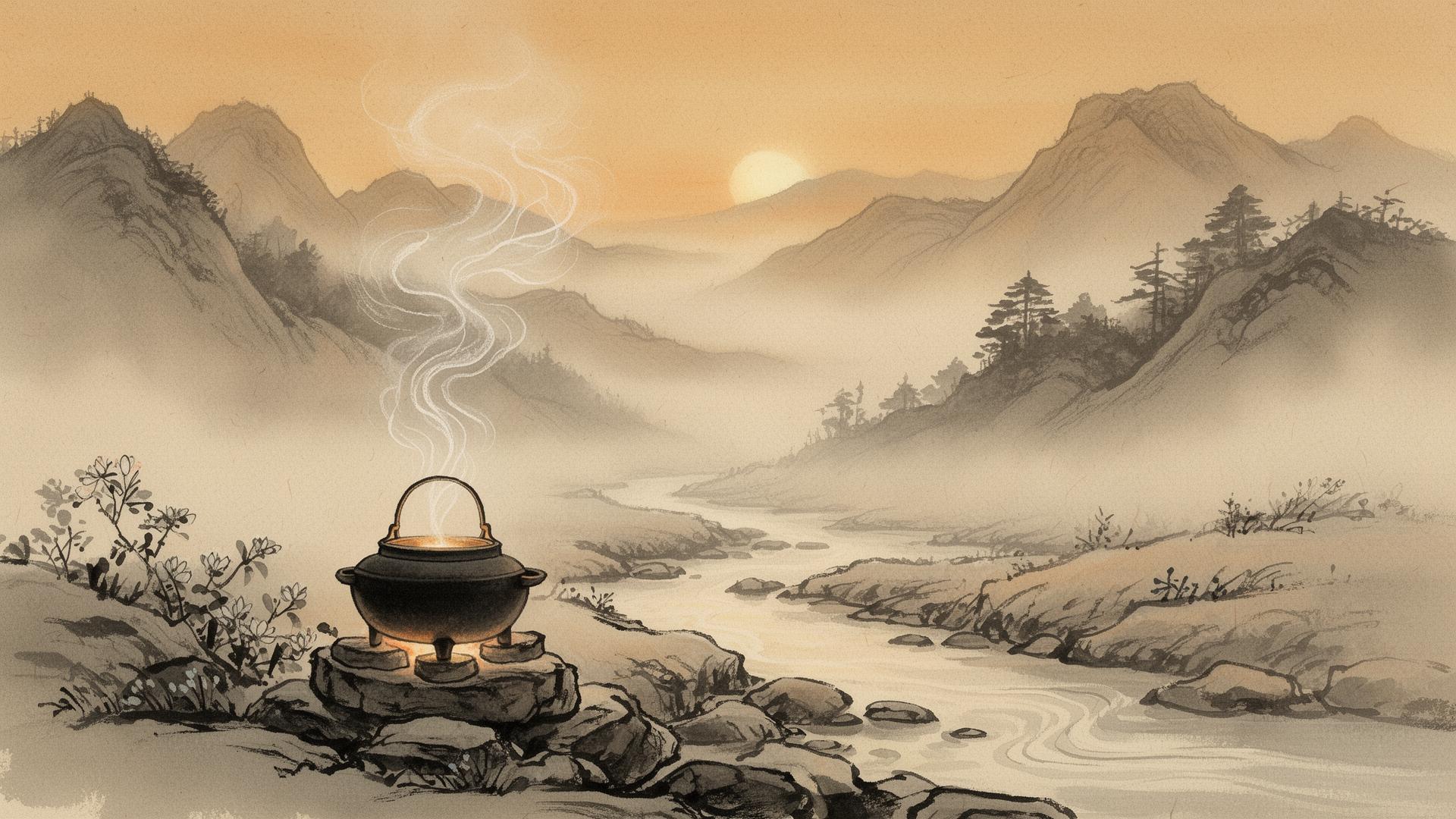
Before refinement, conservation. The lower belly — the lower dantian 下丹田 — is the furnace and the reservoir, where jing 精 is held in its dense, generative form. Most people spend more essence in a day than they could refine in a week. This practice does the simplest, oldest thing: drops the breath low, slows the exhale, and lets the scattered current gather back into the root.
“Can you concentrate your qi 氣 until it is supple, like a newborn child? / The spirit of the valley never dies — it is called the mysterious female. The gate of the mysterious female is the root of heaven and earth.”
— Daodejing 道德經 §10 / §6
- 1Sit upright with the spine tall and the shoulders heavy. Rest both palms gently on the lower belly, below the navel.
- 2Let the breath come and go for a few cycles without changing it. Just notice where it currently lives — chest, throat, shallow, held.
- 3Now invite the inhale to drop lower. Let the belly rise gently under your hands as the lungs fill from the bottom up. Do not push the breath down — let it fall.
- 4On the exhale, let the belly settle. Make the exhale a little longer than the inhale, without strain. The slow exhale is what gathers; the inhale only refills what was emptied.
- 5If the mind wanders into the day's leaks — the unfinished conversation, the worry, the screen — notice without scolding, and bring the attention back to the palms on the belly. Each return is the practice.
- 6After several minutes, stop directing the breath. Rest the hands in the lap. Sit and let the body breathe itself, low and quiet.
- 7Notice the temperature in the lower belly, the steadiness in the seat, the small reserve gathering where there had been scatter. Open the eyes when ready.
Reflection
- Where did the breath live when you first sat down — and where did it settle by the end?
- Which leak did you notice the mind wandering back to? What does that tell you about where the essence has been going?
- How does the body feel now compared to when you began — and what small act of conservation could honour that today?
Refining is gentle work. Every quiet breath gathers a little of what was scattered back into the root. There is no shortcut around conservation — and no need for one, because the slow filling itself is the practice.