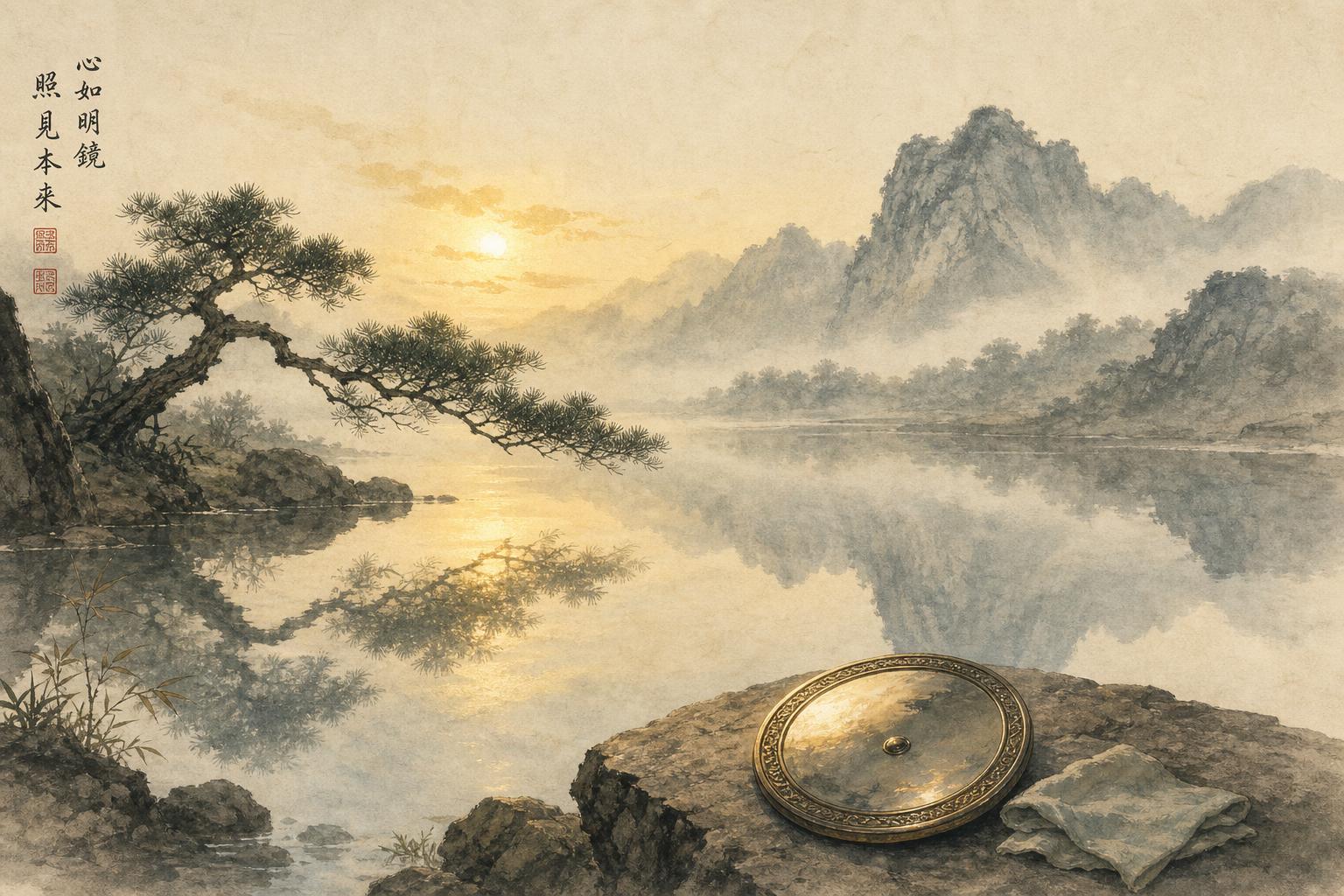
Chapter 18
The Polished Mirror
Change the heart, and the reflection follows.
Polishing
Polishing the mirror is not glamorous. It is the slow clearing of dust — a small resentment let go, a half-truth corrected, a reaction caught before it lands. Each clearing brightens the reflection a little. None of it makes a story worth telling. That is the point.
Don't listen with your ears, listen with your mind. No, don't listen with your mind, but listen with your spirit. Listening stops with the ears, the mind stops with recognition, but spirit is empty and waits on all things. The Way gathers in emptiness alone. Emptiness is the fasting of the mind.
Stop Cleaning the Reflection
When you do not like what the mirror shows, the instinct is to rub the mirror — argue with the situation, manage the other person, rearrange the surface. The Daoist remedy is the opposite. Change the face. Inner change appears outwardly on its own, without persuasion.
Can you polish your mysterious mirror until no flaw remains?
Small Daily Polishes
When the heart is tranquil, the qi 氣 is in order; when the qi is in order, the body is at ease.
The Limits of the Image
Not everything outward reflects the inward. Sometimes the world is simply hard, and no amount of polishing will change it. The mirror teaching speaks only to the part you can change. The rest is met with the steadiness that polishing quietly builds.
Others do not know me; I alone know them (ren bu zhi wo, wo du zhi ren 人不知我,我獨知人). The mirror (xin 心) reflects without being seen.
The Mirror's Quiet
A clean mirror does not announce itself. People are drawn to it because, in its presence, their own face appears more clearly. They cannot always say why they feel met. This is de 德 — the quiet power of a clear heart. It is not performed. It is simply present.
Parable: The Fasting of the Mind
In the fourth chapter of the Zhuangzi 莊子, the disciple Yan Hui asks Confucius how he should approach a dangerous ruler. Confucius answers with a method called xin zhai 心齋 — the fasting of the mind. Make your will one, he says. Do not listen with the ears; listen with the mind. Then do not listen with the mind; listen with the qi 氣. The ear stops at sound, the mind stops at recognition; but the qi is empty and waits on all things without grasping. The Way gathers only in emptiness. This emptiness — the willingness to receive what is in front of you without immediately judging, defending, or rehearsing a reply — is the actual polishing of the mirror. It is not a metaphor — it is the practice.
Core Lesson
Polish the heart. The reflection will follow.
Practice for this lesson
A short practice in xin zhai 心齋 — the fasting of the mind. Rather than rubbing the reflection (arguing with the situation, managing the other person), polish the surface itself: clear one piece of inner dust, then meet the next encounter with an emptier, quieter heart.
“Listening stops with the ears, the mind stops with recognition, but spirit is empty and waits on all things. Can you polish your mysterious mirror and leave no blemish?”
- 1Sit upright. Close the eyes. Take three slow breaths and feel the body settle.
- 2Bring to mind one recent encounter where the reflection was off — a tense exchange, a moment you reacted more than you meant to, a person who keeps mirroring back something you do not like.
- 3Notice the instinct to rub the reflection: to rehearse what they should have said, to fix them, to rearrange the surface. Acknowledge it, and set it down.
- 4Now turn toward your own face in the encounter. What dust was on your mirror? A small resentment, a half-truth, a tone of voice, a private judgement, a wish to be seen as right.
- 5Name one piece of dust honestly — without scolding. Just: 'this was here.' On the next exhale, picture a soft cloth wiping that one spot clear.
- 6Sit for a few breaths with the slightly cleaner surface. Notice that you did not have to change the other person; you only had to clean your side of the glass.
- 7Choose one quiet polish for the next hours: a small truth told, a kindness done unmentioned, an ill word about an absent person withheld, a grievance set down before sleep.
- 8Open the eyes. Carry the clean spot with you. The reflection will follow on its own.
Reflection
- Which encounter did you bring? What were you tempted to rub on the reflection instead of the mirror?
- What one piece of dust did you name on your own surface? What was it like to see it without scolding?
- Which small polish will you actually do in the next few hours — and with whom?
The clarity beneath was always there. You are not making a new mirror; you are clearing one spot of dust, then another. None of it makes a story worth telling — and that is the point.