Chapter 1
The Uncarved Block樸
Before naming, there is only the Way.
The Opening Words
The Daodejing 道德經 — the 'Classic of the Way and Its Power,' a collection of eighty-one short poetic chapters traditionally attributed to Laozi and dated roughly to the 4th century BCE — opens with a paradox on purpose. The moment we put the Way (Dao 道, the seamless pattern in which things naturally arise, sustain themselves, and pass) into words, we have already turned it into one more thing among things. Language is useful, but it slices a seamless reality into named pieces — 'tree,' 'self,' 'success,' 'failure' — and then we mistake the slices for the whole.
The chapter points to two layers of experience. Beneath all our labels there is a nameless source — open, undivided, alive. Out of that source, naming arises, and from naming the familiar world of ten thousand distinct things unfolds. Both layers are real and necessary. The trouble is that most of us live only on the surface of names and forget the depth underneath. The work of inward training is to learn how to return — again and again — from the named world back to the nameless source from which it springs.
The Dao that can be spoken is not the constant Dao; the name that can be named is not the constant name. The nameless (wu ming 無名) is the origin of heaven and earth; the named (you ming 有名) is the mother (mu 母) of the ten thousand things (wanwu 萬物).
Returning to the Uncarved Block
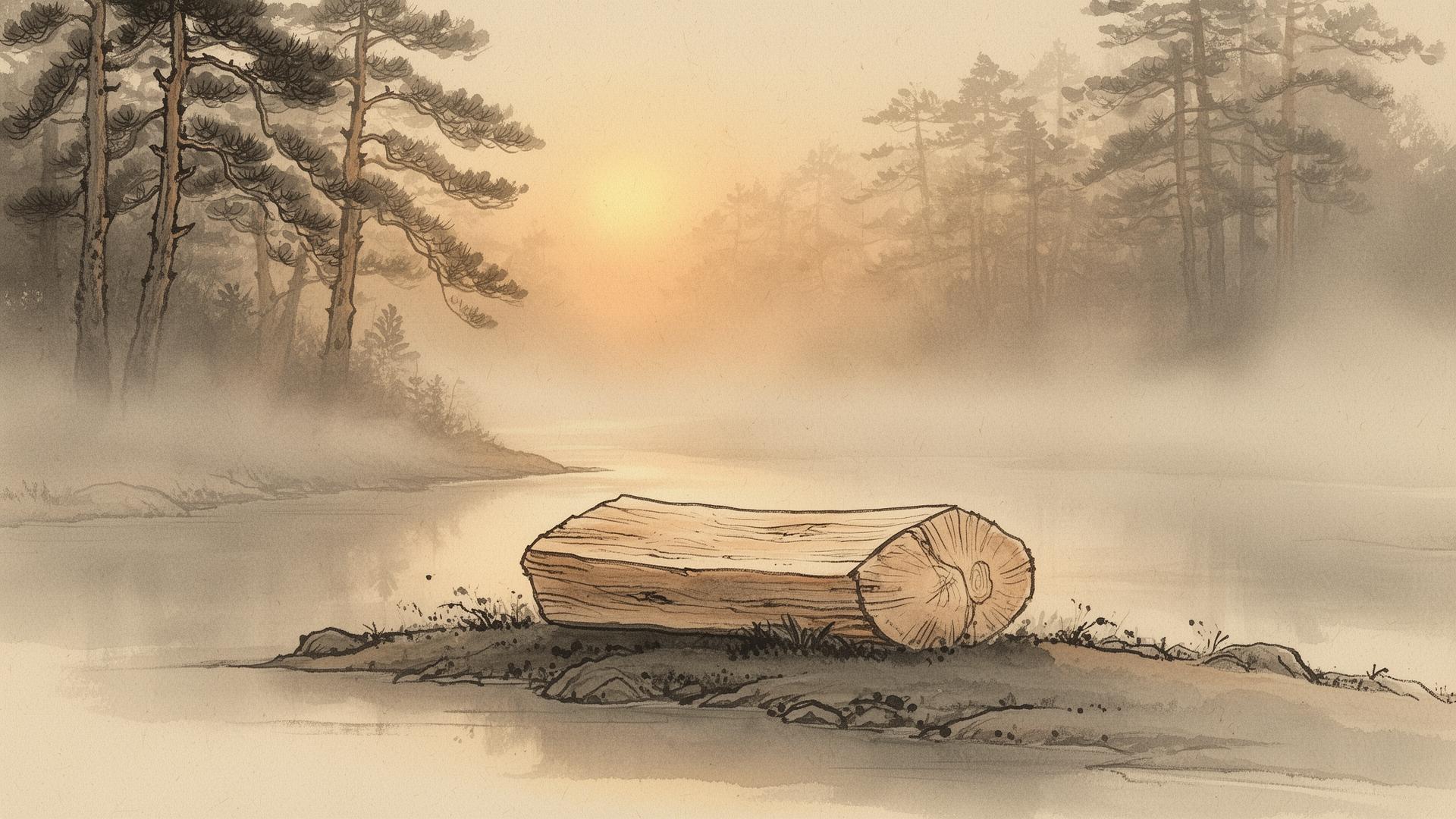
Most people either endure life as a fixed fate or wrestle success from the world by sheer will. Neiye 內業 — 'inner cultivation,' an early Daoist text on cultivating the vital essence by settling the heart and aligning the body, proposes a third way. Instead of resigning or forcing, you return to the original state — the uncarved block (pu 樸) — and from that root let things unfold of themselves (ziran 自然). Pu 樸 is the image of wood before the carver touches it: undivided, simple, full of potential. To 'return to pu' is not to become primitive or empty. It is to recover the wholeness that was there before conditioning, ambition, and fear shaped you into something narrower than you really are. From that ground, action becomes lighter and more accurate, because it is no longer driven by the anxious need to prove or protect a smaller self.
Know the white, but keep to the black; be a model for the world. Return to the state of the uncarved block (pu 樸).
What Is Inward Training?
Inward training is the practical side of this philosophy. Rather than only thinking about the Way, it works directly with the body-mind — with breath, posture, attention, and emotion — to settle what is agitated and uncover what is already whole. The early Daoist texts describe this work in terms of three inner substances and one guiding attitude.
The Three Treasures
Classical inward training works with three substances inside the body-mind. They are not separate organs but three depths of the same living energy.
- Jing 精 — essence, the deep generative substance. Stored low in the body, it is spent through overexertion, restless desire, and chronic stress. The work begins by simply not leaking it: fewer late nights, fewer emotional storms, more rest.
- Qi 氣 — vital breath, the animating current that warms and moves every tissue. Through slow, quiet breathing, scattered qi is gathered back to the centre, where it can circulate freely instead of spiking and crashing.
- Shen 神 — spirit, the clear light of awareness. As jing is conserved and qi settles, shen naturally brightens; the mind becomes lucid and steady. Refined far enough, shen returns to the source from which it came.
Cultivation, Not Creation
A key point for newcomers: you are not being asked to invent a new, better self. The sage 'does nothing, yet nothing is left undone' (wuwei 無為 — literally 'non-doing' or 'effortless action': not the absence of activity, but action that no longer issues from a strained, ego-driven self and so leaves no friction behind it). The task is to stop disturbing what is already whole, so the natural order can reassert itself on its own. Wuwei does not mean passivity or laziness. It means acting from the place before the name has hardened into opposition — before 'me vs. them,' 'success vs. failure,' 'should vs. shouldn't' have taken over. From that quieter ground, response is still possible; it is simply no longer forced.
When the heart is settled within, the eyes and ears are sharp and clear, and the four limbs are firm and fixed — it can thereby serve as a lodging-place for the vital essence (jing 精).
How to Begin
If this is your first chapter, you do not need to master any of these terms. Start with one move: when you notice yourself caught in a strong label — about yourself, another person, or your situation — pause, take one slow breath, and remember that beneath the label there is still a nameless, open ground. That single pause is already a small return to the uncarved block. Everything else in this course is an unfolding of that gesture.
Core Lesson
Return from the named world to the nameless source.
Practice for this lesson
Before the carver touches the wood, it is whole — pu 樸, the uncarved block. This practice is a small setting-down: not adding a new self, but noticing what names you are wearing and letting the wood beneath show through again.
“The nameless is the origin of heaven and earth. / Return to the state of the uncarved block.”
— Daodejing 道德經 §1 / §28
- 1Sit comfortably. Let the spine be tall and the shoulders heavy. Close the eyes.
- 2Take one slow breath. Ask quietly: what name am I wearing right now? A role, a worry, a label about who I should be? Let one name surface.
- 3Notice how the body holds that name — tight jaw, held breath, braced shoulders. Do not fix it. Just see it.
- 4On the next exhale, let the name loosen, like a thin coat you are no longer cold enough to need.
- 5Breathe once more into the nameless place beneath it. No words. No task. Just the uncarved wood, undivided, already whole.
- 6Open the eyes. Carry nothing forward except the knowing that this place is always here, beneath every name you put on.
Reflection
- What name surfaced first? Where did the body hold it?
- What changed — even slightly — when you let the name loosen?
- Can you feel the nameless ground still there, beneath whatever name you pick up next?
The wholeness was never lost. You are only remembering how to stop covering it. Every small setting-down is a return to pu.